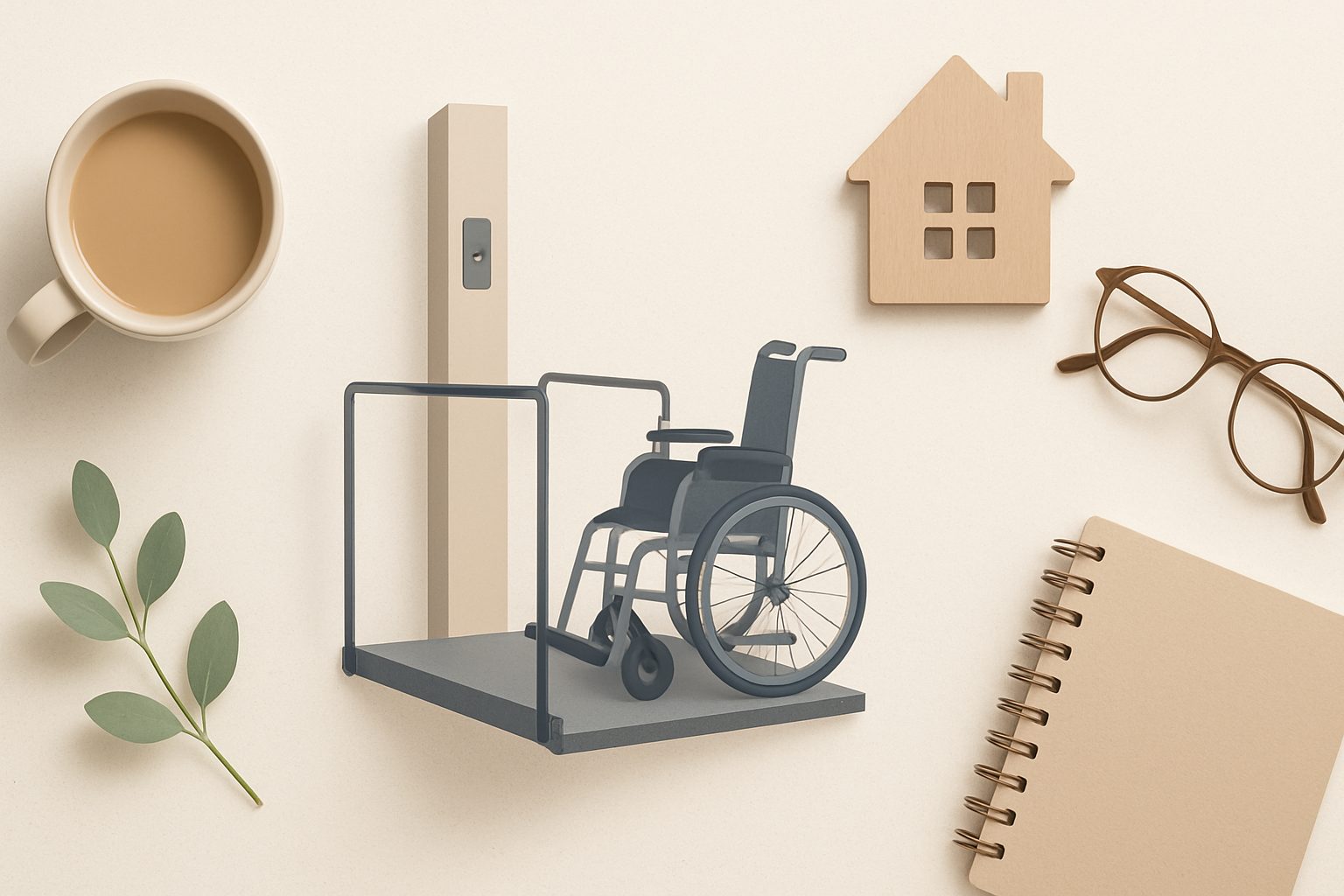
Wheelchair Lift for a Terraced House UK: Compact Options Reviewed
Terraced houses pose a particular challenge for wheelchair access. Unlike detached properties, you're working with shared walls, neighbours' concerns about party-wall agreements, and often just a few metres of garden space. A full-sized platform lift needs 1.5–2 square metres of footprint, which isn't realistic for many urban terraces. But compact lifts do exist—and they're worth understanding before you commit to a ramp or resort to back-garden building works.
Why terraced houses are trickier
Terraced properties account for nearly a third of UK housing stock. The good news: they're often positioned exactly where wheelchair users need to be—town centres, good transport links, shops within reach. The bad news: space is tight.
Your garden might be 3 metres deep. Your neighbour is 60 centimetres away at the party wall. Installing anything permanent needs their consent and a party-wall surveyor, which costs £300–600 and takes weeks. Many terraced-house owners discover they can't fit a standard lift without costly structural work or neighbour disputes.
You also face planning permission risk. Some councils require consent for lifts classed as "engineering works," especially if they're visible from the street. A poorly positioned lift can be flagged by planning enforcement, forcing removal after installation—a costly mistake.
Compact platform lifts that actually fit
The market has responded. A handful of manufacturers now offer narrower platforms and folding designs:
Portable platform lifts are the easiest option. Models like the EasyStair or similar brands offer fold-away platforms roughly 0.6 metres wide and 1.2 metres long when deployed. They're anchored at the top and bottom but don't require permanent installation. Cost is typically £4,000–7,000 installed. The trade-off: they're slower (4–5 minutes to raise or lower) and require anchoring points that must be structurally sound.
Vertical platform lifts (VPLs) are the compact traditional lift. Standard versions are about 1.0 metre wide, 1.2 metres deep, and need minimal depth behind them. Models designed for narrow spaces—such as those from reputable manufacturers like Stiltz or TK Lifts—fit into gaps as tight as 1.1 metres. They're permanent, need electrics and occasionally building control approval, but they're fast (10–15 seconds) and carry 300 kg, so they suit electric wheelchairs and partner assistance.
Outdoor stair lifts with platforms are less common for terraced houses but worth mentioning. They're narrower than lifts but slower than dedicated platforms. Only consider these if you have a single short flight.
Space requirements and party walls
A 1.0-metre-wide compact VPL needs:
- 1.0 metre width
- 1.2 metres depth at the threshold
- 30–50 centimetres clearance behind (for cables and mechanism)
- 2.1 metres headroom above
If your terrace runs parallel to the party wall, that 50-centimetre clearance might breach your neighbour's airspace. You'll need a party-wall agreement.
Portable lifts are more neighbour-friendly because they're not permanent structures. You anchor them to existing door frames and paving—no new building. This still requires survey consent, but the conversation is easier.
Cost and installation reality
A compact VPL installed: £8,000–15,000 depending on electrics, building work, and access.
A portable platform lift: £4,000–7,000 installed.
Neither includes:
- Party-wall surveyor (£300–600)
- Building control inspection if required (£150–300)
- Electrical work beyond the lift itself (£400–800)
- Ramp or threshold adjustment to meet the lift platform (£200–500)
Budget for 10–12 weeks from order to operation. Portable lifts are sometimes faster (6–8 weeks) because they avoid building control.
Planning permission: when you need it
You probably don't need planning if:
- The lift is rear-garden only and not visible from the street
- It's temporary or easily removable
- Your council doesn't classify it as "engineering works" (ring your local planning department)
You'll likely need it if:
- The lift is front-facing
- Your property is listed
- Your terrace is in a conservation area
- It's taller than the garden fence
A pre-application enquiry at your council costs nothing and takes 3–4 weeks. Do this before spending money on surveys.
Terraced-house buyer's checklist
Before committing to a lift:
- Garden depth: Measure from house wall to rear fence. Less than 2 metres? You'll struggle with a standard lift; consider portable or ramp.
- Party-wall position: Which side is the shared wall? Can you site the lift away from it?
- Electrics: Is there a suitable power supply within 2 metres? Adding circuits is expensive.
- Neighbours: Have a chat. Permanent structures need their agreement anyway.
- Threshold height: Is it a single step or a full flight? Single-step access suits ramps; flights need lifts.
- Planning area: Check if you're in a conservation area or have a listed property.
- Drainage: Are there soakaways or drains in the garden? Drilling for foundations can hit utilities.
Should you consider a ramp instead?
Ramps need more horizontal space than lifts do. A 60-centimetre threshold rise requires 6 metres of length at a gentle 1:10 gradient. Most terraced gardens aren't 6 metres deep.
But if you can cascade ramps across a patio or side passage, modular metal ramps (portable, not fitted) cost £1,500–3,000 and need no surveyor, no building control, no neighbour consent. They're worth exploring if your garden can accommodate the run.
The practical reality
A compact lift in a terraced house is achievable, but it's slower and more expensive than fitting one in a detached property. Portable platforms offer a middle ground—easier permissions, lower cost, still permanent enough for daily use. A surveyor visit (£150–250) will tell you whether your specific property can physically accommodate a lift. Do that first, before committing to design or quotes.
More options
- Portable Wheelchair Platform Lifts – Amazon UK (Amazon UK)
- Folding Wheelchair Ramps – Amazon UK (Amazon UK)
- Suitcase & Travel Wheelchair Ramps – Amazon UK (Amazon UK)
- Threshold & Kerb Ramps – Amazon UK (Amazon UK)
- Stairlift & Platform Lift Accessories – Amazon UK (Amazon UK)