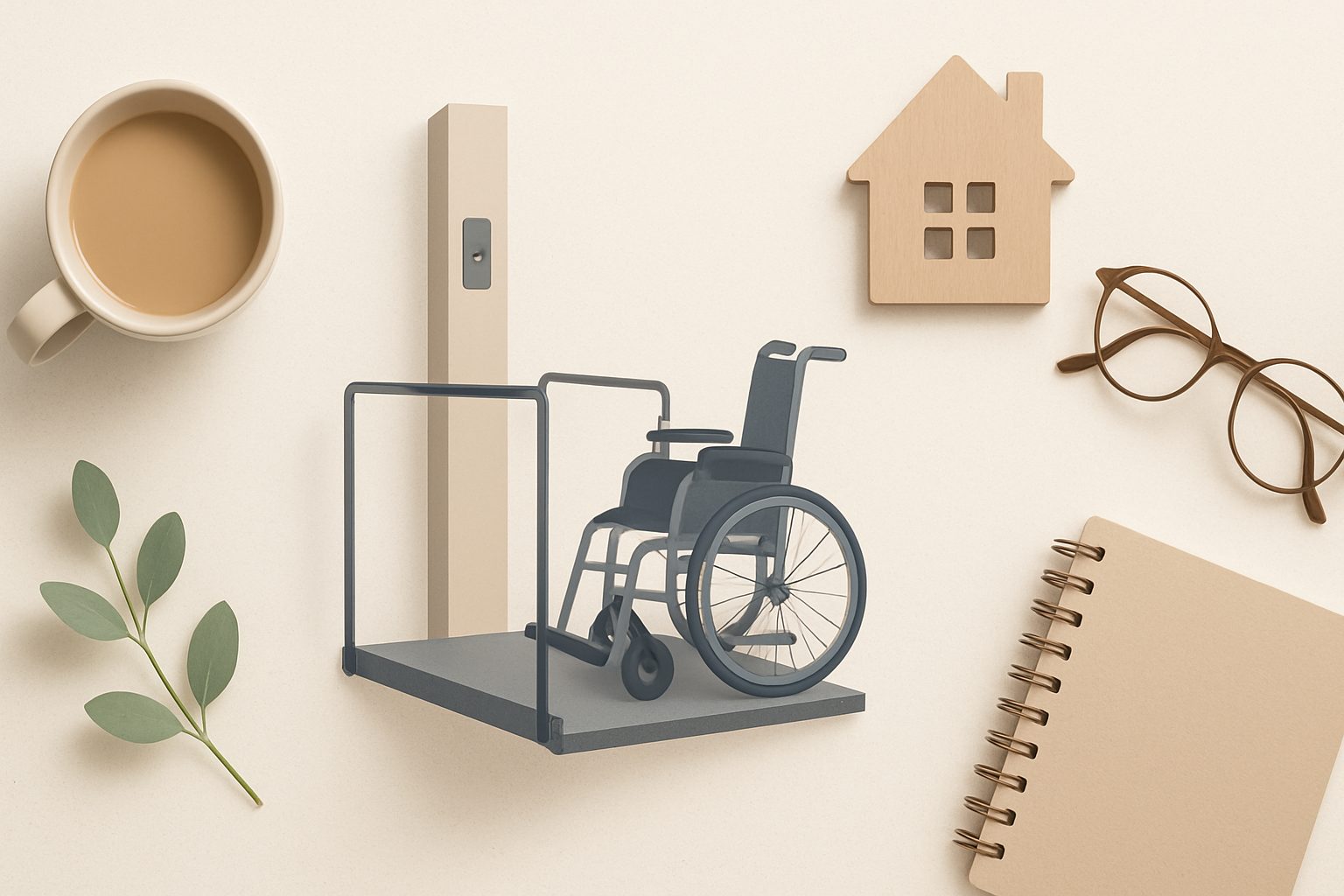
Platform Lift for a Split-Level Home UK: Best Options for Awkward Layouts
Split-level homes are notoriously awkward when mobility becomes a concern. Unlike traditional terraced or detached houses with straightforward layouts, a split-level design means half-landings, short stairways, and uneven floor heights scattered throughout the property. A standard stairlift won't work—you'd need multiple installations or a lift that can handle the irregular geometry. Platform lifts are purpose-built for exactly this problem, though choosing the right one depends on your specific layout and how much space you're willing to sacrifice.
Why Split-Level Homes Need Different Mobility Solutions
Split-level properties became popular in the 1960s and 70s as a way to maximise space on sloped sites. A few steps up or down separate living areas, which looks clever on the floorplan but creates genuine barriers for wheelchair users, people with mobility aids, or anyone whose knees can't handle repeated small climbs.
Installing a conventional stairlift on a half-landing staircase is rarely practical. You're looking at either:
- Installing multiple stairlifts (expensive and disruptive)
- A single stairlift that only serves one section, leaving other parts of the home inaccessible
- Accepting that some rooms become off-limits
A platform lift sidesteps these problems. It takes up floor space rather than hugging the staircase, and it can be installed vertically or at an angle, making it flexible enough to slot into awkward geometries that stairlifts can't manage.
Short-Rise Platform Lifts: The Split-Level Sweet Spot
Most split-level height differences aren't huge—typically between 30 and 60 centimetres per level. This is where short-rise platform lifts excel. They're compact, require minimal structural work, and are far less intrusive than a full-height domestic lift.
Short-rise models are usually straightforward to specify: you measure the height difference, choose a platform size (often 80–100cm wide), and decide whether you want it to rotate at the top. Rotation is useful if the landing space is tight and you don't want to reverse on and off. Most run on 230V domestic power, though installation should always be done by a qualified engineer.
Cost sits between £3,500 and £8,000 depending on features and specification, plus installation. It's significantly less than a full domestic lift but more than a stairlift, so it's worth getting a survey and a few quotes before deciding.
Inclined Platform Lifts for Steeper Layouts
Some split-level homes have steeper intermediate stairs, especially in Victorian conversions or properties with particularly awkward architectures. An inclined platform lift—essentially a platform that travels along a rail at an angle—can handle rises up to about 1.5 metres.
The trade-off is that inclined lifts need more space. A 1-metre rise will require roughly 2 metres of horizontal rail length, depending on the angle. They're also more visible and can dominate a hallway or landing. But if your split-level involves a genuine staircase rather than a couple of steps, this is often the only practical alternative to removing stairs or accepting inaccessibility.
Inclined lifts run £5,000–£12,000 installed, again depending on the exact specification and whether you need custom fabrication for an awkward angle or landing geometry.
Practical Considerations for Installation
Space is your limiting factor. Unlike a stairlift, a platform lift needs floor real estate at the bottom, at the top, and in the middle if it's inclined. Measure your landings honestly—a platform that's 80cm wide and 1.2m deep is a significant footprint. If your half-landing is already tight, you might have to accept it becoming a lift lobby rather than a passageway.
Stairs don't disappear. Unless you can afford to remove the original stairs entirely, you'll still have them adjacent to the lift. This matters if you're hoping the platform lift will make the space feel less cluttered—it won't, because the staircase will still be there.
Maintenance and longevity. Platform lifts are mechanical systems with regular maintenance requirements. Budget for annual servicing and eventual replacement of wear parts like hydraulic seals or guide rails. Many suppliers offer maintenance packages; it's worth factoring this into your decision.
Power and safety. All platform lifts require a nearby power socket. They're also fully enclosed and fall under the Lifting Operations and Lifting Equipment Regulations (LOLER), which means they need to be certified and periodically inspected by a competent person. This isn't a DIY job, and cutting corners on installation is a false economy.
When to Consider Alternatives
If your split-level difference is just one or two steps and you're physically able to manage a handrail and step, a sturdy grab rail or a lightweight portable ramp might suffice. For larger height differences or full-time accessibility needs, a platform lift is usually the only practical middle ground between accepting the barrier and spending £25,000+ on a full domestic lift.
Some people also investigate removing the split-level altogether—rebuilding the floor to a single level—but this is major structural work and typically costs more than the lift would have.
The Real-World Choice
Platform lifts for split-level homes are unglamorous, take up obvious space, and require proper installation. But they solve a genuine problem that stairlifts and ramps can't. If your home's awkward layout has been restricting access to parts of your own property, a platform lift is usually worth exploring seriously—get a surveyor in, get three quotes, and ask to see examples of similar installations if possible.
More options
- Portable Wheelchair Platform Lifts – Amazon UK (Amazon UK)
- Folding Wheelchair Ramps – Amazon UK (Amazon UK)
- Suitcase & Travel Wheelchair Ramps – Amazon UK (Amazon UK)
- Threshold & Kerb Ramps – Amazon UK (Amazon UK)
- Stairlift & Platform Lift Accessories – Amazon UK (Amazon UK)