Best Portable Wheelchair Lifts for Home Use UK: Top Picks 2025
Moving around a home when you use a wheelchair or mobility aid is one of the biggest challenges for independent living. Portable wheelchair lifts offer a practical solution—especially if you rent, live in a property you're not ready to commit to, or need something you can take with you. Unlike permanent installations, these lifts are designed to be moved, stored, or relocated without major building work.
This guide covers the three main types of portable lifts available in the UK: lightweight ramps, folding platform lifts, and battery-powered portable hoists. I've focused on options you'll actually find on Amazon UK and specialist retailers, with honest detail on what works, what doesn't, and who they suit best.
Suitcase Ramps: Lightweight and Genuinely Portable
Suitcase ramps—also called folding ramps—are the lightest option. They fold in half, typically weighing between 9 and 18 kg depending on length and material, and fit in a car boot or under a bed.
What they do well: They're cheap (usually £150–£400), require no power or maintenance, and work for small steps and doorways. Aluminium versions are lighter than steel and won't rust. They're ideal for temporary situations like holiday lets or if you need to get a wheelchair into a single room.
Real limitations: Gradient matters hugely. A 1-metre ramp needs to be at least 10 metres long to meet UK accessibility guidance of 1 in 12 gradient—which most homes can't accommodate. That means steeper angles, which become harder to push a wheelchair up (someone else usually has to help). They're not suitable for permanent outdoor use in bad weather unless you bring them in, and they can be noisy and unstable on uneven ground. They won't help with kerbs or uneven transitions.
If you have a single step of 15 cm or less, a lightweight suitcase ramp is practical. Beyond that, you're fighting physics.
Folding Platform Lifts: Compact Installation
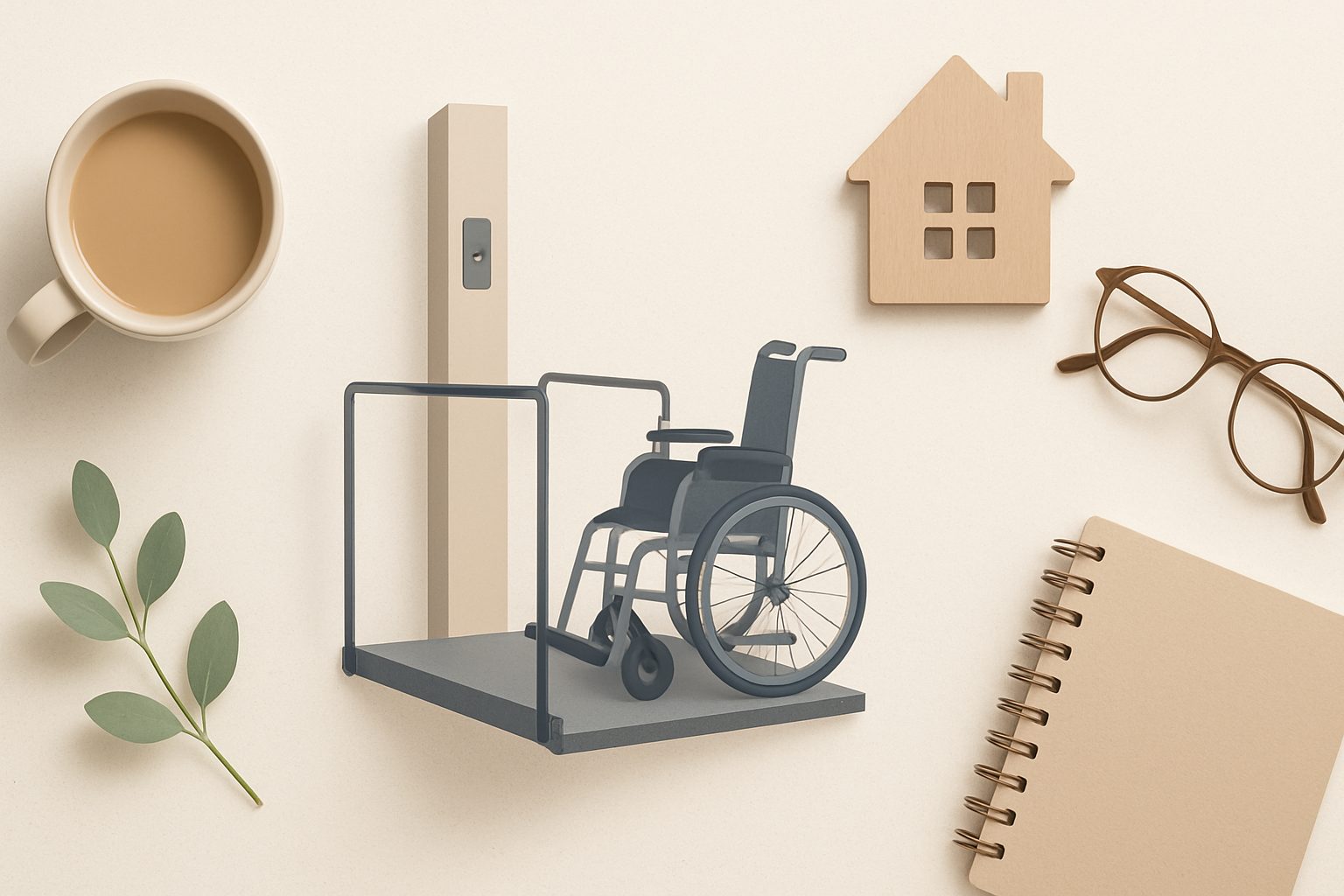
Folding platform lifts sit on a threshold or step and fold flat when not in use. They're electric and powered by rechargeable batteries (usually 24–48V). You drive your wheelchair onto the platform, activate it, and it lifts you over a step or small height. When folded down, they take up less space than a permanent ramp would.
What they do well: They handle steps up to about 60 cm without needing massive space. They're genuinely portable—you can move them to a different threshold or property. Installation is simple (usually just securing to the floor with bolts or adhesive). Battery charge lasts 50–100 lifts depending on the model and load. Running costs are minimal.
Real limitations: They cost £800–£2,500 depending on platform size and weight capacity. Batteries degrade over 3–5 years and are expensive to replace. They need smooth, level ground on both sides to work safely. They're slower than ramps (you can't use one quickly to nip outside). If you have multiple steps at different heights, you'd need multiple lifts. They're not fully weatherproof and battery performance drops in cold weather.
Folding platform lifts suit renters or people with one main problem step—they're the sweet spot between portability and functionality.
Battery-Powered Portable Hoists: Maximum Flexibility
Portable hoists—sometimes called mobile patient lifts—lift you from the wheelchair onto the platform or seat using a mechanical arm and sling. The platform can then navigate steps, kerbs, or thresholds. Battery-powered models weigh around 30–50 kg when standalone.
What they do well: They're genuinely adaptable. You can use them for internal steps, external steps, kerbs, uneven ground, and even to transfer from wheelchair to a car seat. They work on any terrain (no smooth ground required). Some fold or disassemble for transport. They're robust and designed for daily, heavy use. No permanent installation needed.
Real limitations: They're expensive (£1,500–£4,000 for decent models). They're slower than ramps—it takes 2–3 minutes per step. You need space to manoeuvre the hoist and platform. You need someone to operate them safely (not a solo operation). Batteries are heavy and need charging after every few uses. They're bulky for a small home. They can feel undignified compared to independence of a ramp.
Battery-powered hoists are best if you have multiple barriers around your home and need something flexible, or if you share care duties and have someone who can help operate them.
What to Check Before Buying
Weight capacity: Make sure it covers your total weight (you plus wheelchair or mobility aid). Most are rated 100–150 kg. Check manufacturer specs carefully.
Dimensions: Measure your doorways, thresholds, and the spaces where you'll use it. A folding platform lift won't work if your door is 70 cm wide and the platform is 68 cm wide—you need clearance.
Battery type: Lithium batteries are lighter and charge faster. Lead-acid is heavier but cheaper upfront. Check battery lifespan and replacement cost.
Warranty and support: Portable lifts are complex machines. You want 2–3 years' cover and accessible customer support. Brands available on Amazon UK often have good returns policies, which matters if something doesn't suit your space.
Ground condition: Folding platform lifts and hoists need stable, level surfaces. If your ground is uneven, you'll need a concrete pad or ramp approach first.
The Honest Take
Portable lifts aren't one-size-fits-all. Lightweight ramps work brilliantly if you have one manageable step and can manage the gradient. Folding platform lifts are the best compromise if you're renting or flexible about where you need access. Battery-powered hoists cost more but give you genuine flexibility across multiple barriers.
Before buying, be clear about what problem you're actually solving. One troublesome step? Start with a folding platform lift. Multiple barriers or outdoor access? A portable hoist. Just a doorway transition? A suitcase ramp might be enough.
Don't dismiss permanent solutions entirely—planning permission for a modest permanent ramp often takes less time than you'd expect, and it adds long-term value if you own your home.
More options
- Portable Wheelchair Platform Lifts – Amazon UK (Amazon UK)
- Folding Wheelchair Ramps – Amazon UK (Amazon UK)
- Suitcase & Travel Wheelchair Ramps – Amazon UK (Amazon UK)
- Threshold & Kerb Ramps – Amazon UK (Amazon UK)
- Stairlift & Platform Lift Accessories – Amazon UK (Amazon UK)