Best Wheelchair Lifts for Bungalows & Single-Storey Extensions UK
If you live in a bungalow or have a single-storey extension with step access, you might assume wheelchair lifts don't apply to you. Most of the conversation around accessibility lifts centres on multi-storey homes. But bungalows often have their own access challenges: a single internal step between rooms, a raised entrance threshold, access to a utility room, or a step up to a conservatory or newly added annex. These small rises create real barriers—and they have targeted solutions.
Unlike full-height platform lifts designed for staircases, the best options for bungalows are compact, affordable, and often portable. This guide covers what actually works for single-storey properties and what to genuinely consider before buying.
Why Bungalows Still Need Lifts
A bungalow doesn't require the dramatic multi-floor lift you'd install in a terraced house. But many bungalows were built before modern accessibility standards. Ground-level properties often feature:
- Raised thresholds at external doors (typically 150–300 mm)
- Single steps between rooms (common in 1960s-1990s builds)
- Sunken lounges or dining areas (creates a step down)
- Extensions and conservatories with their own step access
- Utility rooms accessed by a single step
A person using a manual wheelchair or a powered chair will struggle with steps as shallow as 50 mm; anything 150 mm or higher is a significant barrier. Even living alone in a bungalow doesn't solve this problem—you need a solution that works independently or with minimal assistance.
Vertical Platform Lifts: The Main Option
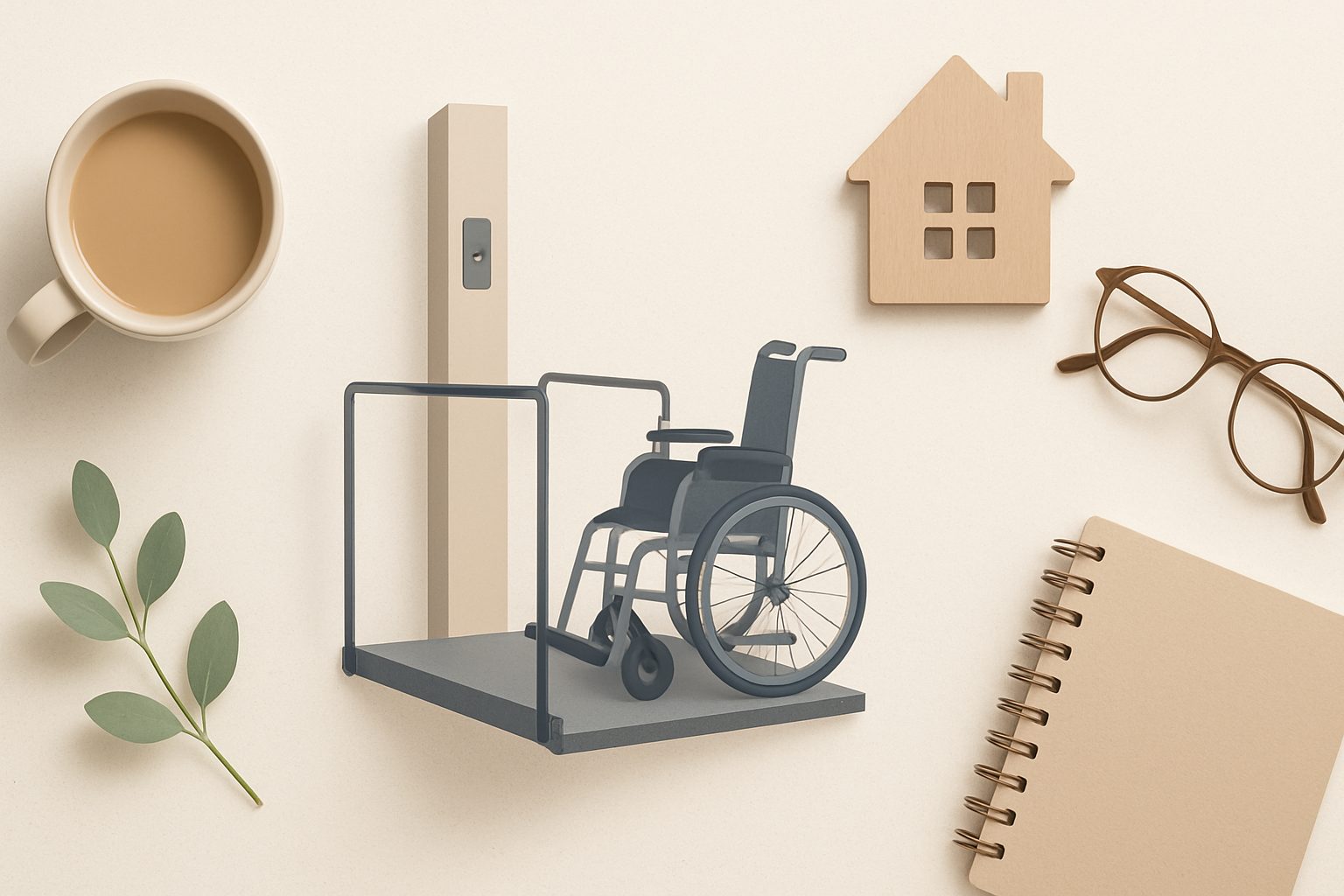
Vertical platform lifts (often called stair lifts' platform cousins) are the backbone of bungalow access solutions. They're compact, stationary lifts that rise vertically and are designed for short runs—typically 1 to 2 metres.
What they do well:
- Suitable for rises from 150 mm up to about 2 metres
- Take up minimal floor space compared to ramps
- No gradient issues or length constraints
- Generally quieter and more discreet than older lift models
- Work outdoors (weatherproof models available) or indoors
Real drawbacks:
- Require fixed installation—not portable
- Typically cost £3,000–£8,000 including installation
- Need a power supply nearby
- Manual operation can be slower than powered alternatives
- Require maintenance (annual servicing is standard)
- Not suitable if you want a temporary solution
Best for: Permanent entrance barriers, internal steps between rooms, conservatory access.
Portable Ramp-and-Lift Combos
For true flexibility, some users combine a portable powered ramp with a lightweight lift system. These devices:
- Fold or collapse for storage
- Move between different step access points in your home
- Typically weigh 20–50 kg (though heavier models exist)
- Powered variants handle most chair types
- Cost ranges from £1,500–£4,000
Limitations: Require clear floor space to deploy, need someone to operate them, and aren't ideal for regular daily use if the step is your main entrance. They work well as a secondary solution—for a rarely-used utility door, or for occasional access to an annex.
What to Check Before Installing
Space: Measure your entrance or threshold carefully. A vertical platform lift requires clear floor space both in front and behind. If your entrance is tight (under 1 metre wide), installation may be difficult or impossible.
Power supply: Most lifts need a 13-amp plug nearby. If your entrance is far from sockets, an electrician will need to extend power (additional cost, typically £200–£600).
Building regulations: Any fixed lift installation needs to comply with Building Regs. If you're in a council property or listed building, there may be restrictions. Check with your local authority before purchasing.
Weight capacity: Most platform lifts support 225–300 kg. Check your chair's total weight, including any baggage or equipment.
Weather exposure: External lifts need weatherproof drive systems and slip-resistant platforms. Standard indoor models will rust outdoors.
Installation and Service
Professional installation is essential and usually takes a full day. Expect to pay £500–£1,500 for labour on top of the lift cost itself. Many suppliers bundle this in, but clarify upfront.
Annual maintenance (usually £200–£400) keeps the lift safe and extends its lifespan. Lifts are generally durable if serviced; many operate reliably for 10+ years.
Cost-Saving Routes
If a new platform lift feels out of reach:
- Check eligibility for a Disabled Facilities Grant (up to £30,000 in England, though usually capped lower). Your local council's Occupational Therapist can assess your needs.
- Some local charities offer second-hand or refurbished lifts.
- Ramp-based solutions (even steep, powered ramps) are cheaper than platform lifts but aren't suitable for all wheelchairs.
The Honest Reality
A vertical platform lift is a substantial investment, but for permanent access problems in a bungalow, it's often the most practical option. Ramps take up too much space; steps damage wheelchairs; and living around an access barrier is exhausting.
For a single small step, a portable powered ramp might genuinely be enough. For your main entrance, a fixed platform lift almost always makes more sense despite the cost—it's reliable, independent, and works in all weather.
The key is clarity about your actual access points and daily routines before you commit to a product. If you're unsure, ask your local Occupational Therapist or request an on-site survey from a specialist supplier—most offer free assessments.
More options
- Portable Wheelchair Platform Lifts – Amazon UK (Amazon UK)
- Folding Wheelchair Ramps – Amazon UK (Amazon UK)
- Suitcase & Travel Wheelchair Ramps – Amazon UK (Amazon UK)
- Threshold & Kerb Ramps – Amazon UK (Amazon UK)
- Stairlift & Platform Lift Accessories – Amazon UK (Amazon UK)