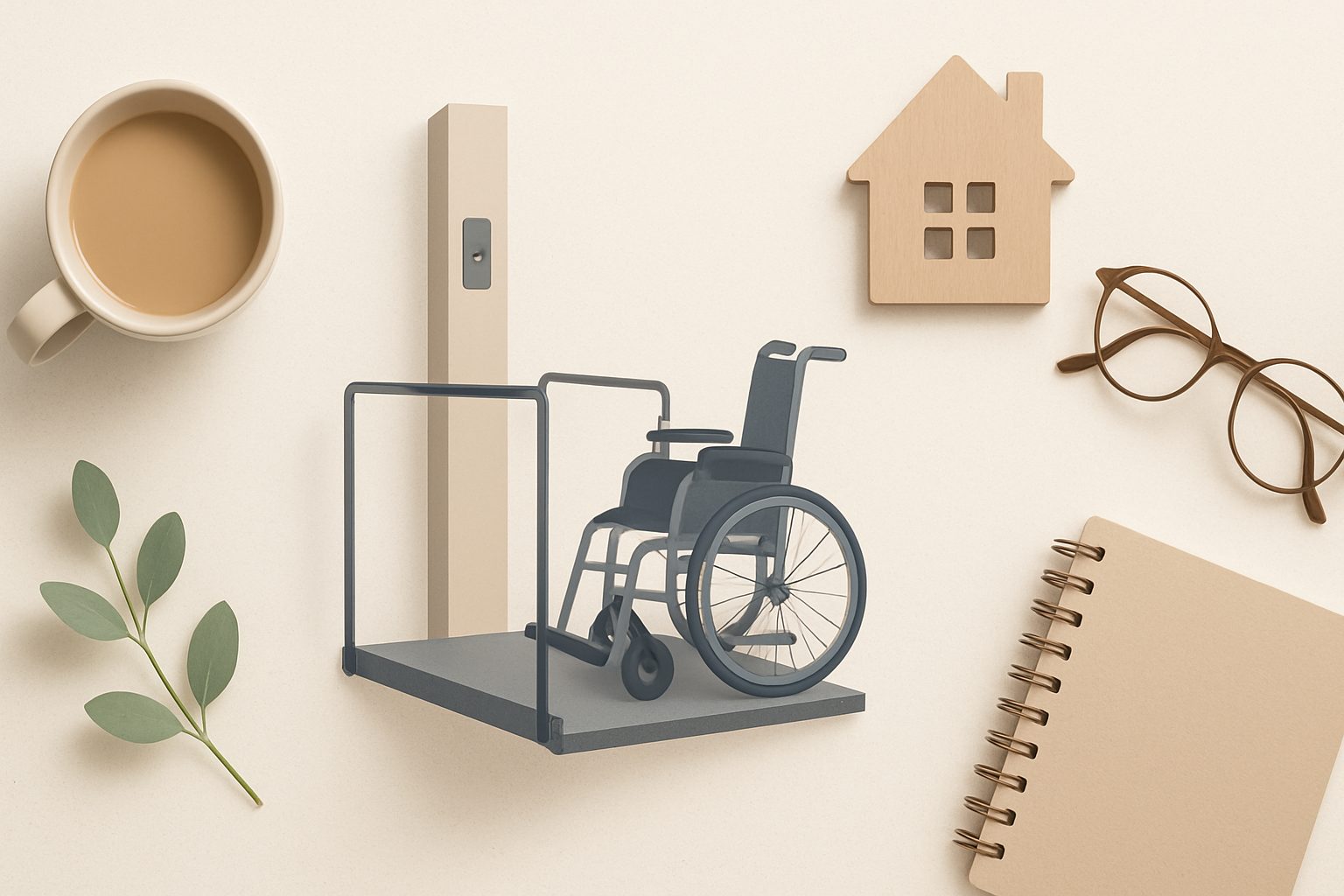
Best Outdoor Wheelchair Platform Lifts for UK Gardens & Split-Level Homes
If your home has steps between levels—a raised patio, a sunken garden, or a front entrance set back from the drive—an outdoor wheelchair platform lift can make the difference between a garden being accessible and it being off-limits. Unlike ramps, which need substantial length to meet accessibility gradients, lifts solve the problem of height differences in compact spaces. But outdoor lifts face challenges that indoor models don't: weather exposure, corrosion, and planning regulations that often catch people off guard.
Why Outdoor Lifts Matter More Than You'd Think
Most mobility solutions focus on getting indoors. Ramps, curved stairlifts, and lift installations are standard. Yet many UK homes have outdoor barriers that isolate people from gardens, patios, or entrances. A step up to a back door or a split-level garden isn't just inconvenient—it makes those spaces genuinely inaccessible. An outdoor platform lift removes that barrier without requiring planning permission in most cases (we'll come back to that), and without eating into garden space the way a long ramp would.
The catch is durability. Unlike an indoor lift working in climate-controlled conditions, an outdoor model must withstand rain, frost, salt air if you're near the coast, and UV damage to plastics and seals. This is why the lifts that work tend to be overspecced compared to their indoor cousins.
IP Ratings and Weather Resistance: What Actually Matters
When shopping for outdoor lifts, you'll see "IP" ratings—these tell you how sealed the lift is against water and dust. The format is IP followed by two digits. The first number (0–6) rates dust/solid protection; the second (0–8) rates water protection.
For an outdoor lift, you want IP54 minimum. This means dust-protected (not dustproof, but sealed against dust ingress in normal use) and protected against water spray from any angle. IP54 is suitable for exposed outdoor locations. Some higher-end models reach IP65 (dust-tight, jets of water) or IP67 (temporary immersion in water up to 1 metre). Don't assume "outdoor" means IP67—many garden-use lifts are actually IP54, which is adequate for the UK climate.
Check the IP rating of the motor, control panel, and power connections separately. A lift motor rated IP65 is good, but if the control box sitting beside it is only IP44, water can still cause problems.
Corrosion Resistance: Materials Matter
UK weather means rain is constant, not occasional. Steel components will rust unless they're galvanised, powder-coated, or stainless. Aluminium corrodes too if it's not anodised. When comparing lifts, ask:
- Is the steel galvanised or painted? Galvanised is more durable than painted steel in wet gardens.
- Is the aluminium anodised? This creates a protective oxide layer. Not all aluminium garden equipment is anodised, and bare aluminium degrades visibly.
- Are fasteners stainless? Cheap stainless fasteners will rust; proper A2 or A4 stainless won't. This matters because a rusted bolt can seize and make repairs impossible.
Plastic components (seals, cable covers) degrade under UV. Quality outdoor lifts use UV-stabilised plastics, but cheap ones yellow and crack within a few years. It's worth asking the supplier what they do about UV protection.
Platform Size and Load Capacity
Standard wheelchair platform lifts have platforms 800–1000mm wide and 1200–1400mm deep. Check your actual chair dimensions—wider specialist wheelchairs might be tight on some models. Most outdoor lifts are rated 300kg, which covers a wheelchair user plus chair (typically 150–200kg), with headroom for larger users.
If you're lifting a mobility scooter instead, you need a heavier model. Scooters weigh 150–300kg depending on type, so a 300kg-rated lift works only if the user weighs under 100kg. Check the combined weight.
Planning Permission and Building Regs
This trips people up. Installing a fixed platform lift outside often requires Building Regulations approval in England, even if it doesn't need planning permission. Platform lifts are treated as fixed machinery. The rule is broadly: if it's fixed, it needs Building Regs. Portable lifts you can remove might not, but permanently bolted lifts do.
Planning permission depends on where you live. In most cases, a small outdoor lift to a back door won't need permission—it's not a building. But if your home is listed, in a conservation area, or on a restricted property, you should check with your local planning authority before buying. The conversation takes ten minutes and saves grief later.
Scotland, Wales, and Northern Ireland have different rules, so check local guidance if you're outside England.
Maintenance and Realistic Lifespan
Outdoor lifts need annual maintenance: oil the chains or belts, check corrosion, test the descent speed (should be controlled, not free-fall), and verify the emergency descent still works. Do this yourself or pay someone to do it—neglect and outdoor lifts don't mix.
A well-maintained outdoor lift lasts 15–20 years. Badly maintained ones deteriorate inside five. The difference is oil, inspection, and catching rust early.
Portable vs. Fixed: A Practical Trade-Off
Portable outdoor lifts (sometimes called "ramp-lifts" or lightweight platform models) are attractive because they avoid Building Regs entirely—you just place them where you need them. They typically weigh 100–150kg and cost less. The downside is they're genuinely portable, meaning you have to position and secure them each time, and they're not as robust as fixed models under regular use. They're better for occasional access than daily use.
Fixed lifts bolt down, require Building Regs approval, cost more, but work reliably every day for years.
The Bottom Line
An outdoor wheelchair lift solves real access problems in compact spaces. The key is matching the right lift—with decent IP and corrosion specs—to your specific height difference and usage pattern. Check planning and Building Regs requirements early, buy something meant for outdoor life (not an indoor lift in a weatherproof box), and commit to annual maintenance. Done right, it transforms how accessible your garden and outdoor areas actually are.
More options
- Portable Wheelchair Platform Lifts – Amazon UK (Amazon UK)
- Folding Wheelchair Ramps – Amazon UK (Amazon UK)
- Suitcase & Travel Wheelchair Ramps – Amazon UK (Amazon UK)
- Threshold & Kerb Ramps – Amazon UK (Amazon UK)
- Stairlift & Platform Lift Accessories – Amazon UK (Amazon UK)